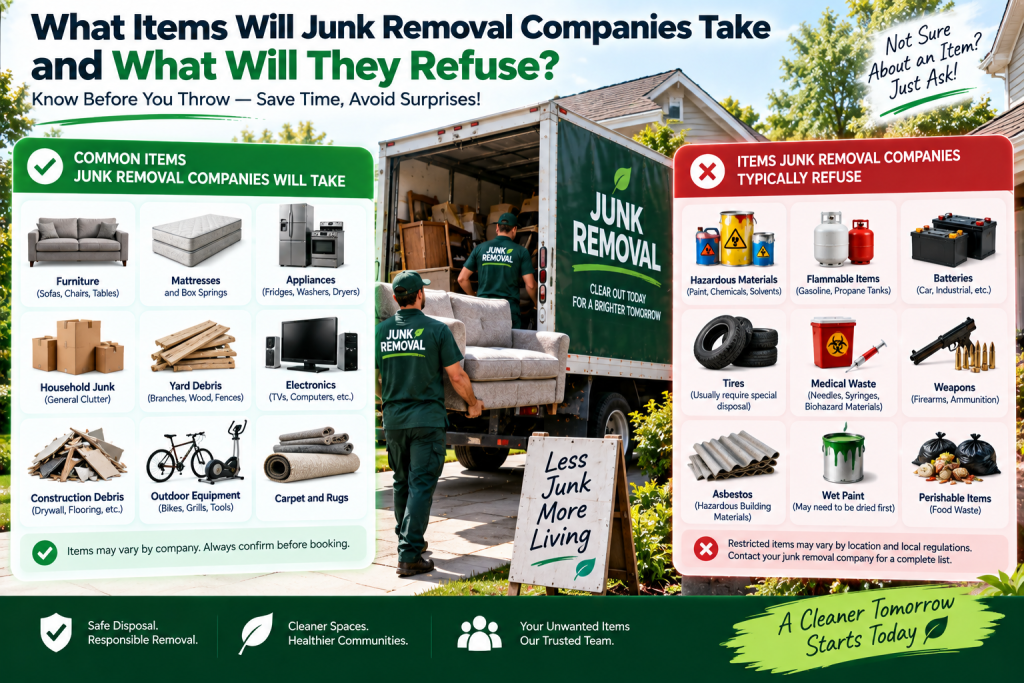

You have an old mattress, broken television, several cans of paint, a damaged desk, and boxes of household clutter.
Can a junk removal company take all of it?
Maybe—but do not assume so.
Accepted items vary between providers and can also depend on local disposal regulations.
Understanding this before booking can save you from an awkward surprise on pickup day.
Common Household Items
Many full-service junk removal companies handle common bulky household items such as:
- sofas and chairs;
- tables and desks;
- mattresses and bed frames;
- cabinets and shelving;
- household clutter; and
- boxes of unwanted belongings.
However, individual policies still apply.
Appliances
Some providers remove household appliances such as refrigerators, washers, dryers, ovens, and similar equipment.
Certain appliances may require special processing.
For example, equipment containing refrigerants may need to be handled according to applicable requirements.
Tell the provider exactly what appliance you have rather than describing it simply as “metal junk.”
Electronics
Old televisions, monitors, computers, printers, and other electronics may be subject to special recycling or disposal rules.
Some junk removal companies accept electronics, while others may direct customers to specialized recycling programs.
Ask before placing electronics in your removal pile.
Yard Waste
Branches, leaves, grass, and other landscaping debris may be accepted by some services.
But again, policies differ.
A company specializing in household cleanouts may operate differently from a business handling landscaping debris.
Describe the material and approximate quantity when requesting service.
Construction Debris
Renovation projects can generate drywall, wood, flooring, fixtures, tile, and other debris.
Some junk removal companies handle these materials.
However, dense construction waste can be extremely heavy, and certain materials may have restrictions.
If your cleanup involves renovation debris, mention this immediately when requesting a quote.
Potentially Hazardous Materials
This is where you should be especially careful.
Products such as chemicals, fuels, pesticides, medical waste, certain paints, and other potentially hazardous materials may require specialized handling.
Do not mix questionable materials into ordinary junk and hope the crew will take them.
Ask directly.
Your local government or waste authority may also provide guidance about appropriate disposal options.
Use the “Would I Pour It Out?” Test
Here is a simple reminder—not a disposal rule.
If an item contains a chemical, fuel, unknown liquid, pressurized material, or something you would be concerned about spilling, stop and ask the provider how it should be handled.
Never dump questionable substances into drains, onto the ground, or into ordinary trash without confirming appropriate disposal requirements.
Make a Photo Inventory
Before calling a company, photograph unusual items separately.
This is particularly useful for electronics, appliances, construction debris, and containers with labels.
The company can then better understand what you are asking them to remove.
Final Thoughts
Professional junk removal services can handle a wide variety of unwanted items, but they cannot necessarily take everything.
The safest approach is simple:
When in doubt, ask before pickup day.
Describe unusual materials accurately, send photographs when possible, and follow local requirements for anything the company cannot accept.
A five-minute conversation can prevent delays and help ensure that your unwanted items are handled appropriately.