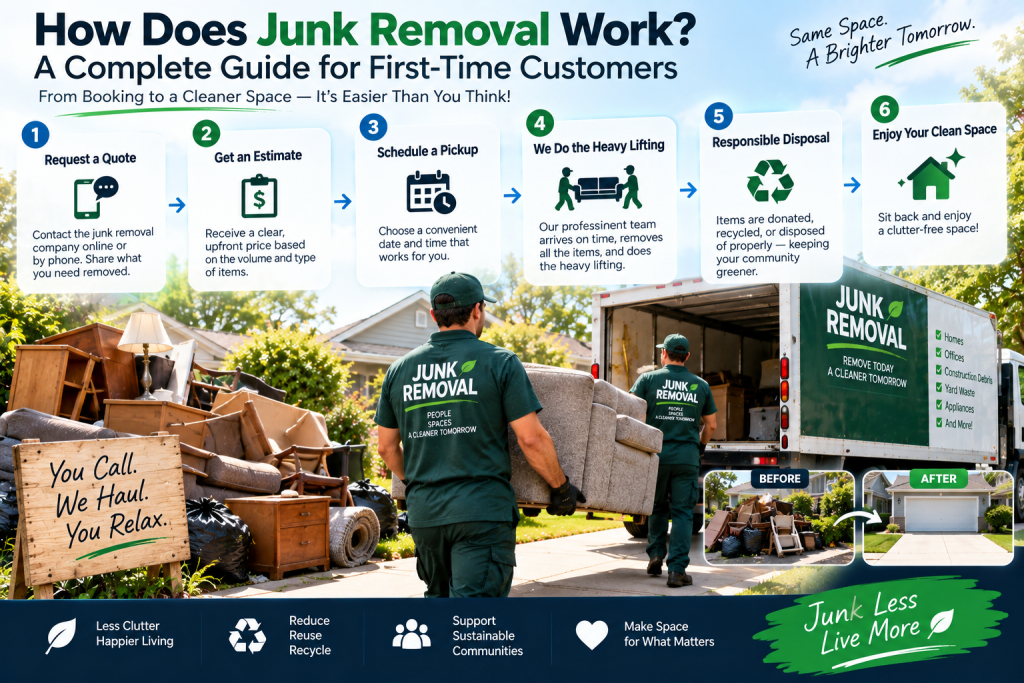

You have finally decided that the old furniture, broken appliances, and mysterious boxes in your garage need to disappear.
Now what?
If you have never hired a junk removal service before, the process can seem unfamiliar. Fortunately, most jobs follow a relatively simple sequence.
Let’s walk through it from beginning to end.
Step 1: Decide What Needs to Go
Start by walking through the property and identifying unwanted items.
You do not necessarily need to organize everything perfectly. However, separating items you definitely want removed from things you plan to keep can prevent confusion.
Try creating three categories:
KEEP
REMOVE
NOT SURE
That last category is surprisingly useful. You can make final decisions before the crew begins loading.
Step 2: Contact a Junk Removal Company
Next, contact one or more local providers.
Be prepared to explain:
- the types of items involved;
- the approximate quantity;
- your property type;
- whether stairs or elevators are involved;
- where the items are located; and
- whether anything is especially large or heavy.
Photographs may help the company understand the project.
Step 3: Request Pricing Information
Depending on the provider and job, you may receive an initial estimate remotely or an on-site quote.
Ask whether the estimate is binding or subject to change.
Also ask what could cause the final price to increase.
For example, discovering significantly more junk than originally described could change the scope of the job.
Step 4: Schedule the Pickup
Once you are comfortable with the company and pricing process, choose an available appointment.
Ask whether you need to be present.
If you live in an apartment or managed property, check whether there are rules regarding elevators, loading zones, parking, or service access.
Planning these details ahead of time can save considerable frustration.
Step 5: Confirm the Items
When the crew arrives, walk through the property and identify everything being removed.
This is your opportunity to clarify anything that changed after booking.
Maybe you found another chair in the basement.
Maybe you decided to keep a table.
Speak up before loading begins.
Step 6: The Crew Loads the Junk
With a full-service removal company, the crew generally handles the physical loading.
This is particularly useful for bulky furniture and large quantities of clutter.
Make sure pathways are reasonably clear and keep children and pets away from active work areas.
Step 7: The Items Leave the Property
Once loading is complete, the crew transports the materials away.
What happens next depends on the provider and the materials collected.
Some items may be donated, others recycled, and the remainder disposed of through appropriate facilities.
If this matters to you, ask about the company’s process before booking.
Step 8: Check the Area
Before the crew leaves, take a quick look around.
Did everything you requested get removed?
Did anything intended to stay accidentally get mixed into the removal pile?
This final inspection takes only a few minutes and can prevent problems.
Try This Before Your Appointment
Take a photograph of every room or area containing junk.
Then review the pictures and ask:
“Is everything visible here supposed to leave?”
It is a simple way to catch forgotten items and clarify your instructions.
Final Thoughts
For first-time customers, junk removal is usually much less complicated than it initially appears.
Identify the items, explain the job, understand the pricing, schedule the pickup, and confirm everything before loading begins.
Good communication is the key.
Once you know how the process works, that garage, basement, spare room, or office full of unwanted items suddenly feels much easier to tackle.